






Announcement

Save Your Spot — 12 Days of ZFS: Practical Tips, Tricks & Treats (Live Webinar) Learn More

Klara

Webinar Overview

ON DEMAND

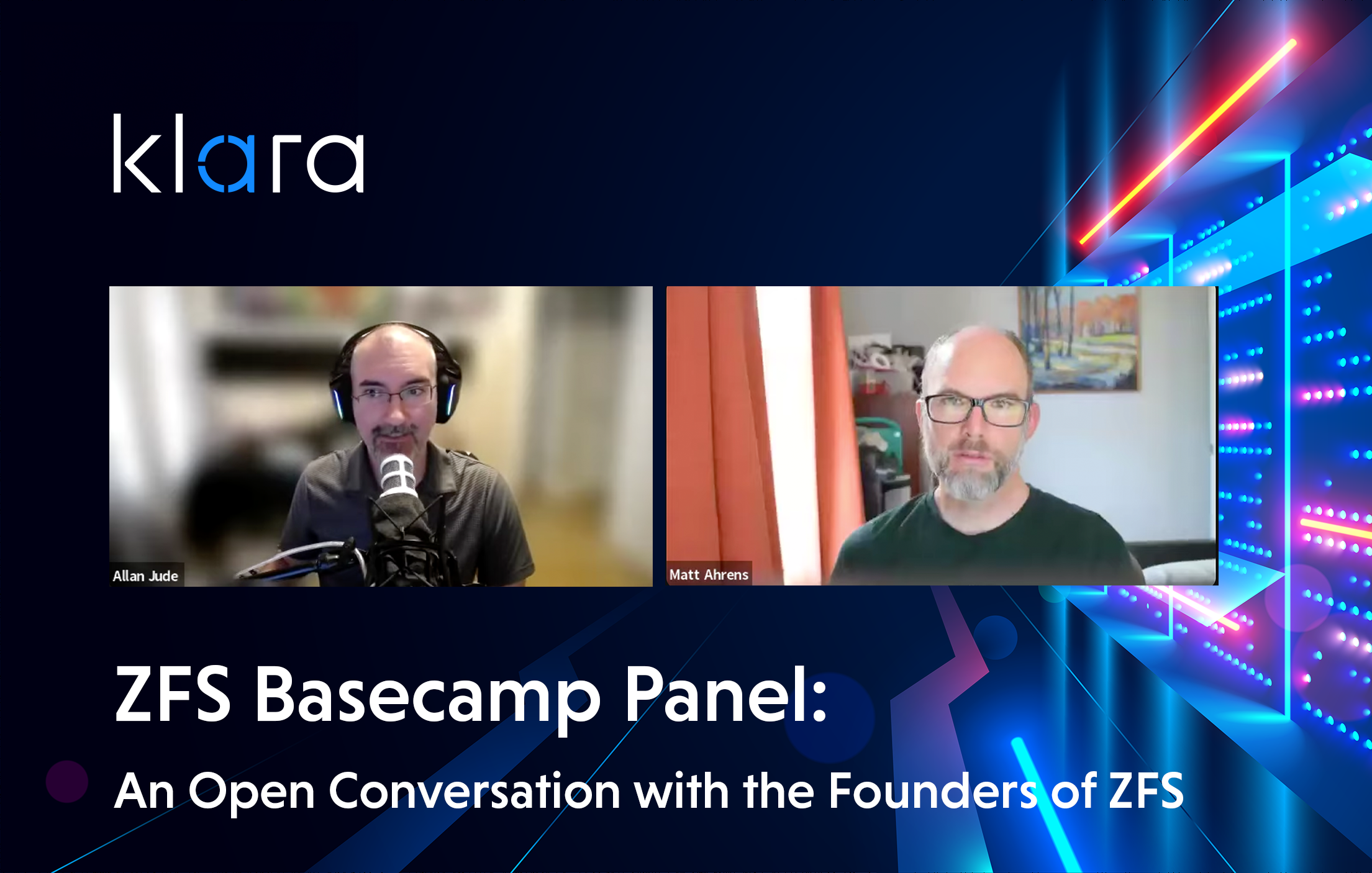
Join us for the launch of ZFS Basecamp with a live panel featuring some of the most recognized contributors and practitioners in the ZFS community, including Matt Ahrens, co-founder of ZFS and creator of the OpenZFS community.

We’ll explore the history, current innovations, and real-world use of ZFS, with open discussion on where the technology is headed. A unique chance to hear directly from the people shaping open-source storage.

What You’ll Learn:

  • How and why ZFS was created
  • How ZFS became open source
  • Current innovations driving ZFS development today
  • How ZFS is adapting to newer storage technologies

Top Questions from the Session—Answered!

🗨️ What has been most surprising about the way ZFS has evolved?

     The surprising part has been the long path of incremental evolution—starting with Solaris, then OpenSolaris, Illumos, FreeBSD, Linux, and finally reaching today’s unified OpenZFS codebase. That unification showed the design was clean and universal enough to work across many platforms and communities. Another turning point was Oracle’s acquisition of Sun and the closure of the source code, which could have ended ZFS development. Instead, it pushed the community to regroup, leading to OpenZFS becoming stronger and more collaborative than before.

🗨️ What is the future of ZFS? What major features may be implemented or what important milestones are going to be reached?

     OpenZFS 2.4 has just branched and continues the traditional annual release cadence. Upcoming work includes performance enhancements and better support for NVMe devices with large sector sizes, zvol lifecycle improvements, and enhanced use of special device classes for ZIL, metadata, and deduplication. The focus continues to be on on durability, scalability, adapting to modern hardware, and aligning with enterprise and open-source goals.

🗨️ What is your favorite thing about ZFS replication?

     The best part is knowing for sure that your data is exactly right after it's copied. When replication completes and the snapshot appears on the other side, you can be 100% sure all your data is there. There's no guesswork, no need to verify piece by piece. Either the snapshot is fully there, or it isn't, and that certainty is why we like it so much.


Date: September 18, 2025
Time: 11:00 AM EDT
Duration: 50 minutes.
Know someone else who might be interested? Share this entry with them!
LinkedIn
Facebook
Reddit
Meet the Hosts

Principal Solutions Architect and co-Founder of Klara Inc., Allan Jude has been on the team since the beginning. Shepherding an amazing team of developers and sysadmins, he is the technical heart of our team. A community go-to person for ZFS and open source through and through, Allan enjoys spending his time improving on ZFS, FreeBSD and making open source code better.

Learn About Klara

Co-founder of the ZFS project at Sun Microsystems, Matthew Ahrens designed and implemented major ZFS components, including snapshots and remote replication. Matt created the OpenZFS community and annual Developer Summit, fostering collaboration across FreeBSD, Linux, macOS, and illumos. He holds a degree in Computer Science from Brown University and is an inventor on more than 20 patents in file system technology.

Alexander Motin is a FreeBSD and Linux OS kernel developer with 20 years of experience in storage, networking, and related areas. He has been a ZFS developer for 12 years—first in FreeBSD, and later in the OpenZFS project after the merge. He is an Engineering Fellow at TrueNAS and an active committer to the OpenZFS project.

Alan Somers has been a FreeBSD src committer since 2013, focused on storage. He lives in Colorado with 6 other mammals and 10 computers, spending too much time with the computers for the other mammals’ liking.  By day he cures data loss at a backup and disaster recovery company.