Operating infrastructure securely involves more than just installing security updates. Systems need to be configured correctly, monitored over time, and maintained with a clear understanding of how the FreeBSD security process works.
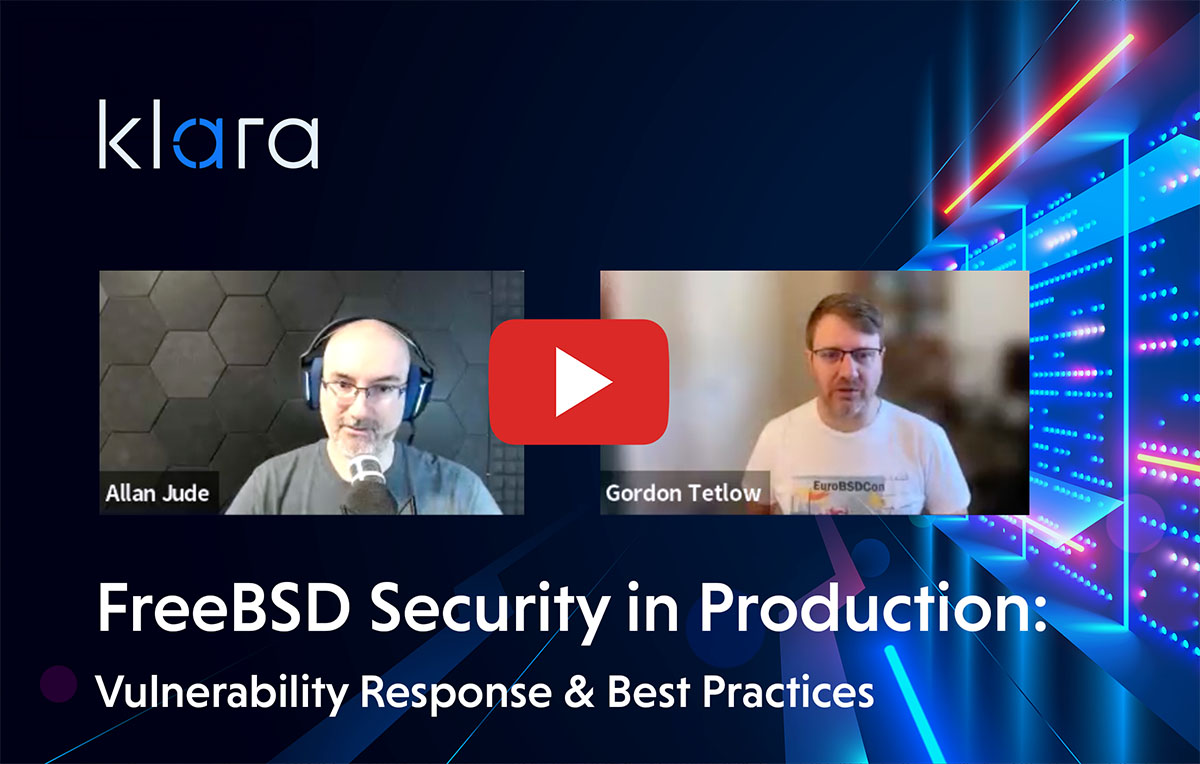
Join Klara’s Allan Jude and FreeBSD Security Officer Gordon Tetlow for a technical discussion on securing production FreeBSD systems. The session covers the security mechanisms available in FreeBSD, best practices for applying them, and will cover how the FreeBSD Security Team investigates vulnerabilities, publishes advisories, and delivers patches for supported releases.
We'll also discuss common operational mistakes that increase risk in production environments and learn how experienced FreeBSD operators reduce that risk without creating unnecessary operational overhead.
What you'll learn :
- An overview of FreeBSD security features, including jails, Capsicum, the MAC Framework, secure levels, privilege separation, and the FreeBSD security advisory process.
- Security best practice recommendations for production systems, including service configuration, access control, and system maintenance.
- How the FreeBSD Security Team evaluates vulnerabilities, coordinates fixes, and publishes FreeBSD Security Advisories (FreeBSD-SA).
- Common operational issues that affect production security, such as delayed patching, unnecessary exposed services, inconsistent system configuration, and unsupported software versions.
Top Questions from the Session—Answered!
🗨️ How can you securely deploy OS and package updates to an isolated security-critical FreeBSD appliance (already using Veriexec and immutable ZFS filesystems)?
Using your internal root of trust, build base packages, then sign them using your existing signing infrastructure. Apply that over a new ZFS boot environment (that isn’t yet sealed and immutable); you maintain trust because you only accept base packages that are signed, then seal the filesystem and reboot onto it. For an isolated system, you still need a secure way to get the update files onto the appliance.
🗨️ How do you manage FreeBSD versions when using custom MAC modules or patches?
As long as there are no ABI changes, a custom MAC module can remain separate from FreeBSD and be compiled against each matching kernel. For example, a module written for FreeBSD 13 will work on all versions of 13, and the same code will most likely work on FreeBSD 15; it just needs to be recompiled. Such MAC modules are often done as ports kmods, making them easy to manage and to compile for mixed versions of FreeBSD.
🗨️ How can Package Base updates be automated safely, similar to unattended upgrades on Ubuntu?
With ZFS, create a new boot environment from the current environment and apply the package updates there instead of to the running system. If the update succeeds and passes your tests, reboot into the new environment. If it fails, discard it. The previous boot environment remains the default until the update succeeds.
Date: September 2, 2026
Time: 11:00 AM EDT
Duration: 50 minutes.