











About HexOS
HexOS is a modern home-server operating system built to make ZFS-backed storage accessible, reliable, and intuitive for everyday users. The team’s mission is to blend enterprise-grade infrastructure with approachable design, helping users build and manage powerful home servers with confidence.
Location: United States
Founded: 2024
Industry: Storage Software
Initial Challenges and Why HexOS Sought ZFS Expertise
Early in HexOS’s development, the team recognized that ZFS brought both enormous benefits and significant architectural complexity. As they began shaping features like Buddy Backup, replication, encryption, and pool-management workflows, they wanted confidence that their design decisions aligned with proven ZFS best practices.
“Prior to working with Klara, we were novices in the world of ZFS and its best practices,” said Jon Panozzo, CEO and Co-Founder of HexOS.
Through a trusted referral, Jon connected with Klara to establish a strong technical foundation before accelerating feature development. Working closely with the HexOS team, Klara provided high-level architectural guidance across several critical areas:
- Replication
- Encryption models and key management
- Pool-creation rules
- Safe operational boundaries
This guidance helped HexOS make early design decisions with greater clarity and confidence, reducing uncertainty around complex ZFS internals. “It provided us with a solid foundation from which to build,” Jon said.
That foundation would later prove essential as HexOS took on more ambitious work—including the development of ZFS AnyRaid.

The Technical Challenge: Wasted Storage in Mixed-Drive Pools
HexOS users typically expand storage incrementally, adding drives over time as storage needs grow. However, traditional ZFS layouts impose a rigid constraint: all drives within a VDEV must effectively operate at the size of the smallest disk. In mirror and RAID-Z configurations, this means larger drives are capped to match the smallest drive in the group, leaving significant capacity unused.
“All of these VDEV technologies require that all of your disks be the same size. If you’re working at enterprise scale, that’s fine. But if you’re running a server at home, upgrades become much more expensive and time-consuming,” said Paul Dagnelie, Principle ZFS Developer at Klara Inc.
The existing design works well in environments where drives are purchased in matched sets, but it becomes costly and inefficient for home users. Upgrading storage often requires replacing every drive in a VDEV at once, rather than swapping in larger disks gradually. Even when newer ZFS features allow expansion, the process can involve extensive data reshuffling and long-running operations.
“People don’t buy perfectly matched drive sets. They upgrade over time, and ZFS historically punished them for that,” said Jon.
As a result, users face higher upgrade costs, longer maintenance windows, and reduced flexibility—challenges that run counter to HexOS’s goal of providing an approachable, adaptable storage experience.

This gap between raw capacity and usable space highlighted the need for a fundamentally more flexible approach to storage layout—one that could take advantage of mixed-drive environments without compromising ZFS’s reliability guarantees.
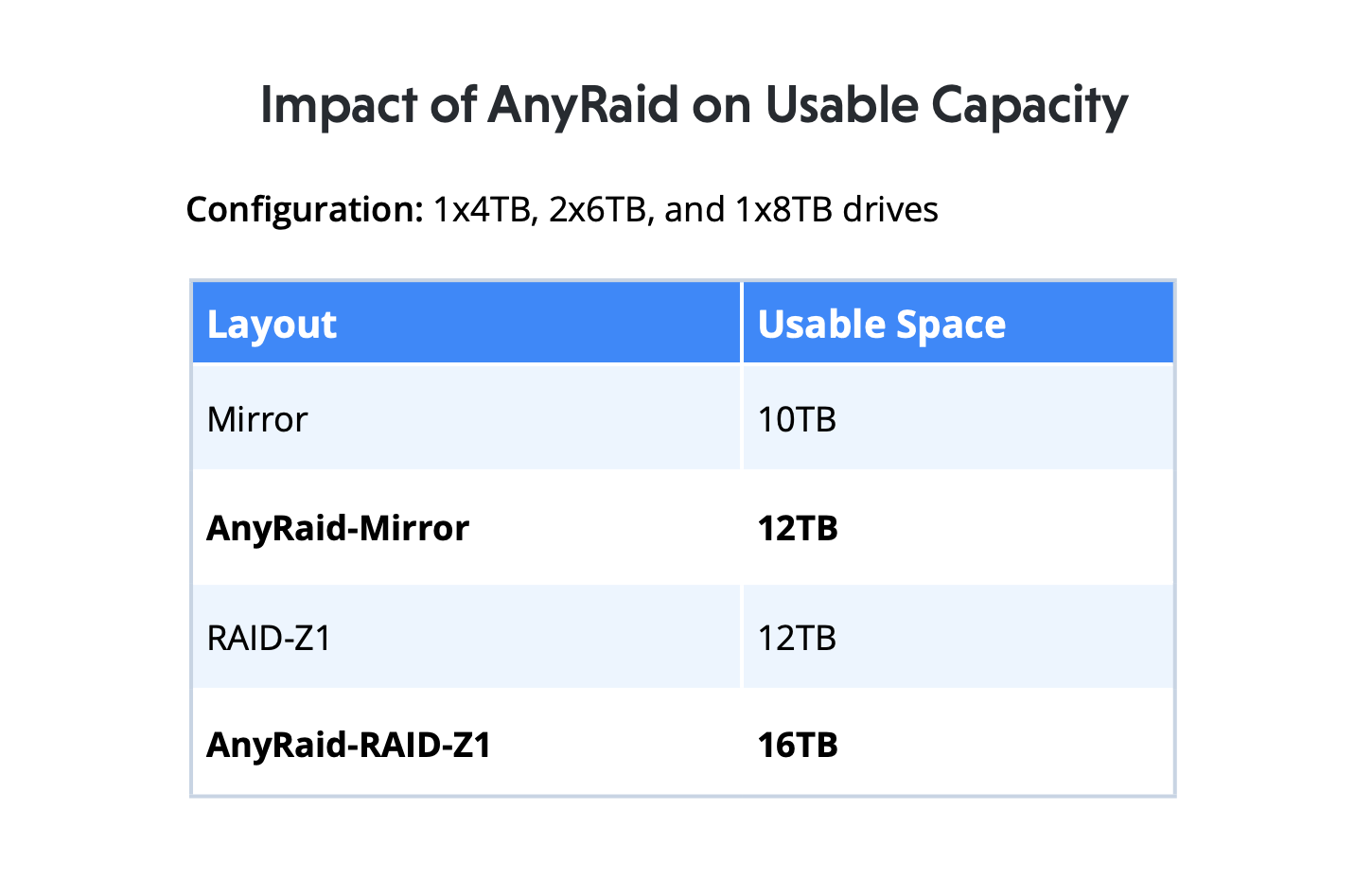
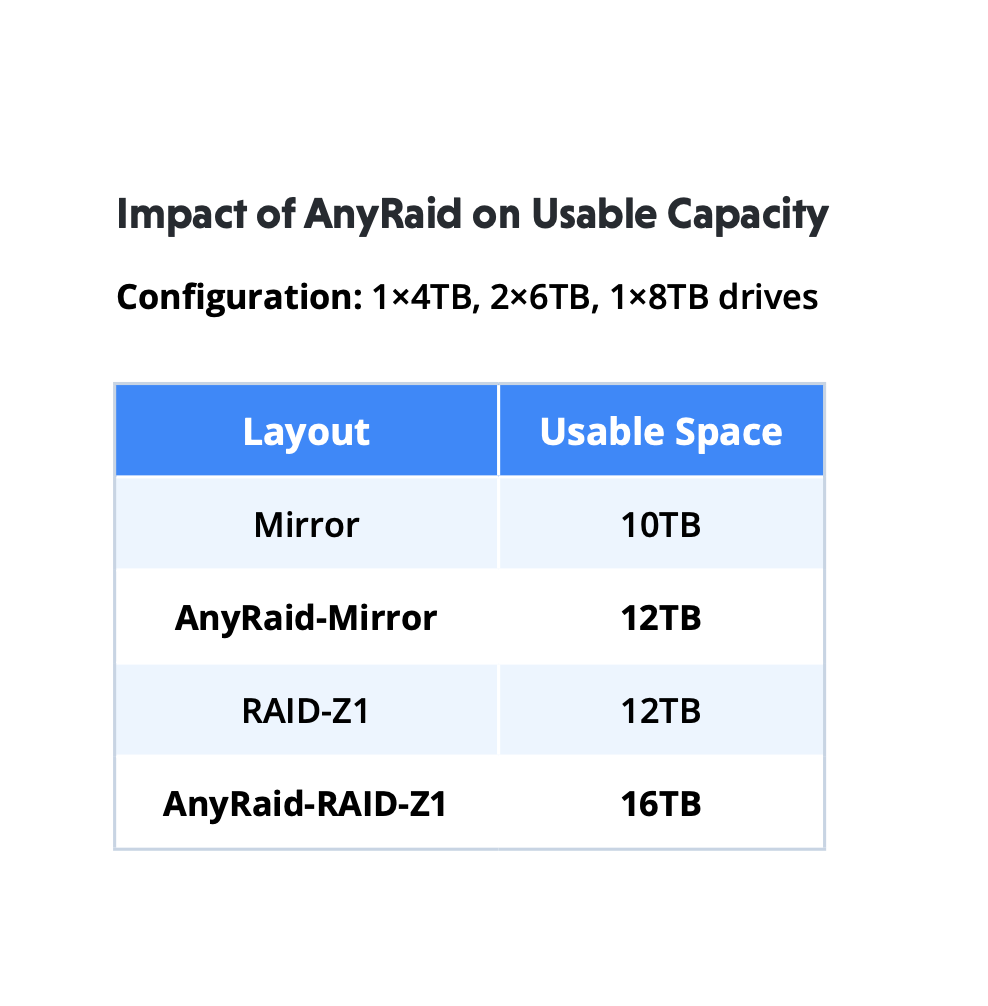
In this example alone, AnyRaid increased usable capacity by 20–33% compared to traditional mirror and RAID-Z layouts, using the same set of drives. For HexOS users who expand storage incrementally, reclaiming this otherwise stranded capacity represents a meaningful improvement in efficiency without requiring changes to hardware or redundancy levels.
Mixed-drive support quickly became one of the most-requested improvements from the HexOS community.
This gap between raw capacity and usable space highlighted the need for a fundamentally more flexible approach to storage layout—one that could take advantage of mixed-drive environments without compromising ZFS’s reliability guarantees.
In this example alone, AnyRaid increased usable capacity by 20–33% compared to traditional mirror and RAID-Z layouts, using the same set of drives. For HexOS users who expand storage incrementally, reclaiming this otherwise stranded capacity represents a meaningful improvement in efficiency without requiring changes to hardware or redundancy levels.
Mixed-drive support quickly became one of the most-requested improvements from the HexOS community.
The Solution: ZFS AnyRaid, Developed by Klara
To solve this, HexOS partnered with Klara to create a new VDEV type that extends ZFS’s flexibility while preserving its integrity guarantees. Klara’s engineering team delivered several core advancements:
- New AnyRaid VDEV type
- Indirection Map for flexible data placement
- Adaptive tile architecture enabling data layout adjustments
- Optimized tile allocation algorithms
- Support for checkpoint, sequential resilver, mirror parity, and RAID-Z parity
- Data rebalancing to improve performance on nearly full pools after they are expanded
“This allows us to preserve the same reliability guarantees that mirrors and RAID-Z provide. If you lose a device, you can still reconstruct all of your data.” said Paul Dagnelie, Principle ZFS Developer, Klara Inc
These capabilities were presented by Paul at the OpenZFS Developer Summit 2025, demonstrating meaningful progress for the entire ZFS community.
The Solution: ZFS AnyRaid, Developed by Klara
To solve this, HexOS partnered with Klara to create a new VDEV type that extends ZFS’s flexibility while preserving its integrity guarantees. Klara’s engineering team delivered several core advancements:
- New AnyRaid VDEV type
- Indirection Map for flexible data placement
- Adaptive tile architecture enabling data layout adjustments
- Optimized tile allocation algorithms
- Support for checkpoint, sequential resilver, mirror parity, and RAID-Z parity
- Data rebalancing to improve performance on nearly full pools after they are expanded
“This allows us to preserve the same reliability guarantees that mirrors and RAID-Z provide. If you lose a device, you can still reconstruct all of your data.” said Paul Dagnelie, Principle ZFS Developer, Klara Inc
These capabilities were presented by Paul at the OpenZFS Developer Summit 2025, demonstrating meaningful progress for the entire ZFS community.
Major new ZFS features—such as DRAID, RAID-Z expansion, or other more involved features—have historically taken many years to be designed, implemented, and integrated upstream. This resulted in an expectation in the community when AnyRAID was announced that it would similarly be years before the feature was available.
“The sheer speed at which AnyRaid is being developed has blown away our expectations.”
Jon Panozzo, CEO and Co-Founder at HexOS
A Collaborative Partnership Aligned on Mission
Throughout the project, the alignment between HexOS’s goals and Klara’s engineering approach was clear.
“The team at Klara clearly understood the mission behind our product and where we needed assistance,” emphasized Jon
Klara’s expertise complemented HexOS’s vision, allowing the team to advance features and make architectural decisions with confidence.
“We’re incredibly excited to continue our relationship with Klara to bring even more valuable features to ZFS and our users in the future,” observed Panozzo.

Impact and Expected Benefits for HexOS Users
AnyRaid directly supports the ways HexOS users build and expand their systems:
- Greater usable capacity with mixed-drive sizes
- Flexible, incremental upgrade paths
- Better hardware efficiency
- No compromise to ZFS’s integrity model
“With this architecture, it’s very easy to add new drives and have that space immediately available—without rewriting how data is laid out.” — Paul Dagnelie, Principle ZFS Developer, Klara Inc.
The community responded quickly. “The community reaction to AnyRaid has been incredible,” said Jon Panozzo, CEO and Co-Founder of HexOS. “This unlocks something users have wanted for years.”
HexOS can now build future storage features — like Buddy Backup and VDEV expansion — on a clearer, more reliable foundation.

Outcomes to Date
“Klara gave us the blueprint we needed. We didn’t know what we didn’t know.”—Jon Panozzo, CEO and Co-Founder of HexOS.
AnyRaid is the product of a thoughtful collaboration between two teams with complementary strengths. HexOS has brought a clear understanding of user needs and a vision for a more flexible ZFS experience. Klara brought the expertise required to extend ZFS in a safe, maintainable, and community-minded way. Together, they delivered a meaningful advancement for the ZFS ecosystem. And for HexOS, it sets the stage for continued innovation.

20–33% Higher Usable Capacity
In mixed-drive configurations, AnyRaid increased usable capacity by 20–33% compared to traditional mirror and RAID-Z layouts, using the same drives and the same redundancy levels.

Lower-Cost, Incremental Upgrades
AnyRaid allows users to add larger drives over time and benefit from additional capacity immediately, avoiding costly, all-at-once VDEV replacements.

ZFS Reliability Preserved
AnyRaid maintains ZFS’s integrity guarantees. Support for mirror parity, RAID-Z parity, and established resilver mechanisms ensures data remains fully reconstructible after device loss.

Production-Ready Architecture
Core AnyRaid functionality is implemented and advancing rapidly, providing HexOS with a stable architectural baseline for future storage features.

Long-Term Roadmap Clarity
Driven by strong community demand, the collaboration with Klara clarified HexOS’s long-term storage roadmap and unlocked future capabilities.