













Key Takeaways
- FreeBSD jails provide operating system-level isolation through a native kernel subsystem.
- Jails integrate directly with ZFS, VNET, Capsicum, and the MAC Framework.
- Unlike Linux containers, jails prioritize simplicity, transparency, and predictable security boundaries.
- ZFS snapshots, replication, and dataset management make jails ideal for long-lived infrastructure services.

Over the past decade, containers have emerged as a dominant tool in modern infrastructure. They play a critical role in DevOps workflows, CI pipelines, and cloud-native application design. Linux-based solutions such as Docker and LXC are often treated as defaults for workload isolation. Their ecosystem is mature, the tooling is expansive, and their popularity shows no sign of slowing down.
Yet not every environment benefits from their complexity. Not every use case aligns with the assumptions baked into container-first workflows. In many infrastructure scenarios, especially those that require long-lived services, controlled security boundaries, and minimal operational complexity, FreeBSD jails remain a strong alternative.
This post will explore the core mechanics of FreeBSD jails, how they differ from Linux-based containers, and why they continue to provide real operational advantages.
What Are FreeBSD Jails?
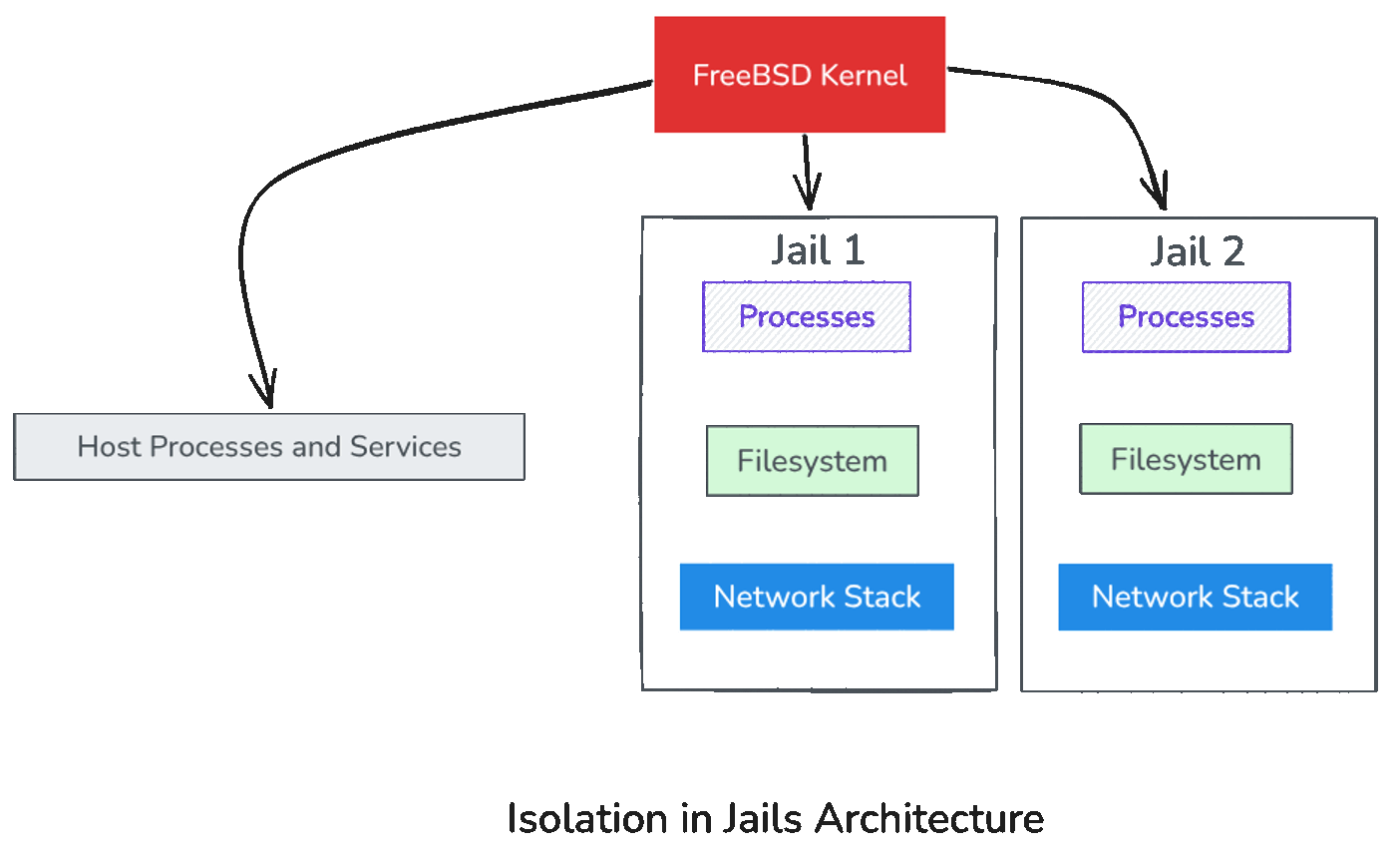
At their core, jails are simply a feature of the FreeBSD kernel, a syscall (jail(2)) that initiates and enforces environment boundaries. Every jails’ process tree runs under the same kernel, but from their internal perspective, they appear to be self-contained systems. A process inside a jail cannot manipulate kernel tunables belonging to other jails, cannot see other process trees, and cannot cause device node side-effects. These are coarse but high-confidence boundaries.
A jail provides an isolated user space that behaves like a full system, but shares the underlying FreeBSD kernel with the host. Each jail has its own process space, file system view, hostname, IP configuration, and user database. Processes running inside a jail are restricted from accessing or observing anything outside their defined environment.
The jail feature debuted in FreeBSD 4.0 back in early 2000. It was intended to sandbox the “omnipotent” root processes, giving hosting providers a lightweight way to partition their hardware among tenants without full virtualization.
Since that early work, jails have steadily gained capabilities
- VNET (virtualized network stack) brings full network namespace separation to jails. Introduced later, VNET enables each jail to have its own interface set, routing tables, firewall rules, and link-level behaviors.
- ZFS dataset delegation enables jails to have assigned portions of storage pools with quotas, snapshots, replication, deduplication, and compression. These controls live in the dataset, not the jail config.
- Capsicum limits process capabilities via file descriptors, enforcing at the syscall level.
- MAC Framework and securelevel provide layered access restrictions that can further lock down jail processes.
These integrations are cumulative. Unlike container runtimes that reinvent abstractions, jails extend the existing FreeBSD model in a controlled, platform-native way.
A jail is created via a configuration entry that defines its identity: hostname, IP address, root directory, and flags for syscalls or capabilities. The administrator invokes service jail start or uses tools like iocage. Once launched, jail-specific services initialize as if on a separate machine. They can register via rc.d, run background tasks, create logs, use cron or periodic, and behave like persistent infrastructure.
The lifecycle of jails is transparent and you can start, stop, or halt them using native commands. Monitoring, debugging, and inspecting jails is identical to the host, tools such as top, ktrace, gdb, dtrace, and zpool operate without jumping through container-specific hoops.
Jails vs Containers: A Structural Comparison
Viewed broadly, FreeBSD jails and Linux containers both provide process isolation and resource partitioning without requiring hardware virtualization. That superficial similarity masks a deeper divergence in architectural choices and system behavior.
Isolation: Assembled Primitives vs. Purpose-Built Subsystem
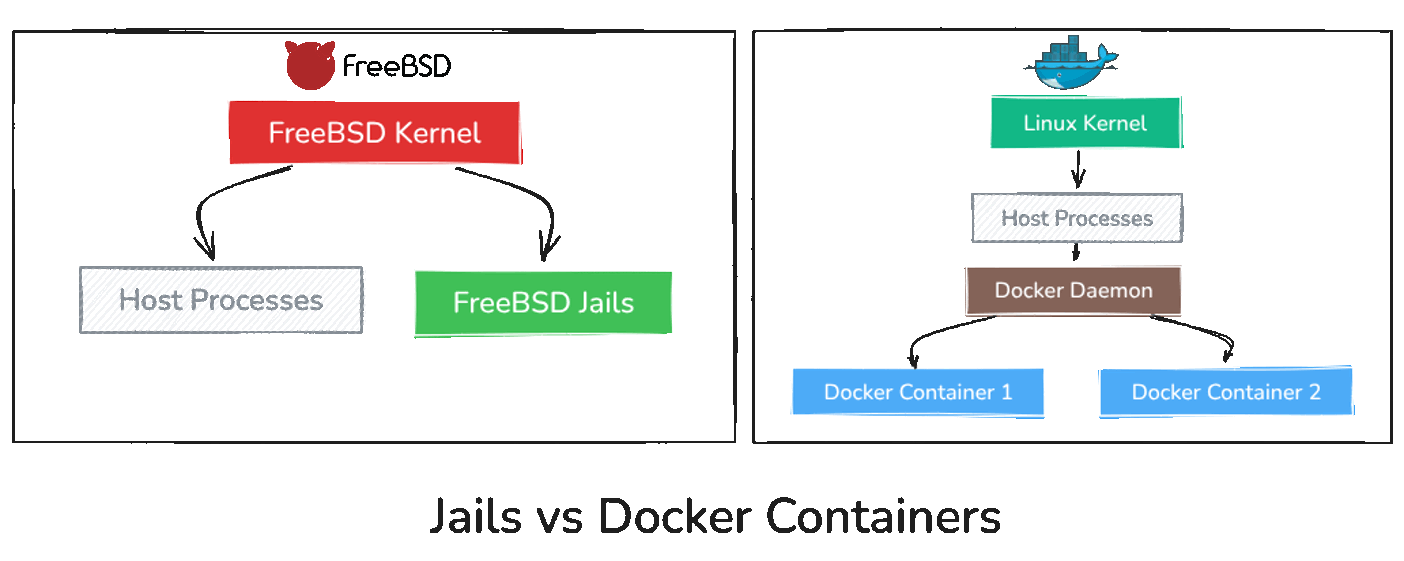
Containers on Linux, particularly those managed using Docker, achieve isolation by composing several kernel features: namespaces for process, mount, user, IPC, UTS, and networking separation; control groups for limiting CPU, memory, and I/O; and security modules like AppArmor or SELinux for policy enforcement. These primitives are not part of a unified container model. They were developed independently and were later repurposed for containerization. To bridge the gaps, projects like Docker, runc, containerd, and CRI-O impose additional user-space abstractions and conventions, often mediated through daemons and layered filesystems.
Jails are different, as they rely on a purpose-built kernel subsystem. There is no separation between the isolation mechanism and the operating system itself. FreeBSD enforces jail boundaries directly, using rules baked into system calls and kernel policies. The isolation is not configured through a runtime shim or daemon but defined through native configuration and loaded by system startup scripts.
From an operational standpoint, this matters. In a jail-based system, administrators know exactly which resources are visible and which are not, as each jail is named global object with an ID. This makes it easy for them to know which interfaces a jail can bind to, which filesystems it can mount, which syscalls are blocked, and which user IDs exist within the environment. These are deterministic properties of the configuration, not the result of container image layering, runtime defaults, or orchestration side-effects.
In contrast, Linux containers are constructed by layering multiple namespaces such as process, mount, user, and more, none of which have global IDs. These components are loosely associated and hard to identify without proper inspection.
Deployment Model: Runtime Layers vs System-Level Transparency
Another key difference lies in the deployment model. Docker containers are typically constructed using layered images, beginning with a base and adding filesystem diffs on top. These layers are stored using union mounts like OverlayFS, which introduce their own semantics and performance implications. Containers are then started using the Docker daemon, which manages their lifecycle and exposes a management API.
FreeBSD Jails, by contrast, are not layered. Their filesystem is a fully materialized directory hierarchy, either extracted from a FreeBSD base tarball or built via make world. Administrators configure a jail's environment with complete control, without being bound to any specific image format or toolchain. As there is no overlay filesystem, performance is more consistent and predictable, especially under I/O pressure or after successive updates.
In practice, this difference plays out in how services are treated. Docker containers are ephemeral by default. They are routinely stopped and restarted, updated by replacing images, and often run under supervision of an orchestrator. Jails, on the other hand, are stable long-running compartments. They are managed like hosts: initialized at boot, persisted across updates, logged in to for debugging, and integrated with the same monitoring stack as the base system.
Security Boundaries: Variable Policy vs Deterministic Enforcement
Security boundaries follow a similar pattern. Linux containers depend heavily on kernel namespaces and user remapping. In theory, these provide isolation, but in practice, configurations vary between distributions, capabilities are often overly permissive, and the Docker daemon must be treated as root-equivalent. Jail security boundaries are more uniform. The kernel enforces them at the system call level. Further hardening is possible through the MAC framework and Capsicum, both of which are native and maintained in sync with the kernel.
While LXC reduces complexity compared to Docker, it still inherits the limitations of containerization on Linux: shared kernel security boundaries, layering systems like OverlayFS, and variability in user-space tools across distributions.
Why FreeBSD Jails Still Deserve Attention
It is tempting to frame jails as a relic from the pre-container era, a solution that predates Kubernetes and thus has been surpassed by newer tooling. This framing overlooks the specific engineering trade-offs that make jails uniquely suitable for certain workloads. Jails are not a weaker alternative to containers. They are a different answer to a different question.
FreeBSD Jails were never meant to offer application portability across diverse environments. They were built to subdivide a single FreeBSD system cleanly and securely. That constraint creates operational benefits as there are fewer assumptions, fewer layers, and fewer surprises.
Services running in jails benefit from clear and robust security boundaries. There are no user namespaces to misconfigure or overlay file systems to degrade under load. Similarly, there are no runtime daemons that restart unexpectedly or leave dangling mount points. The jail is visible, auditable, and inspectable from the host using standard tooling.
In infrastructure environments, especially those involving mail transfer agents, recursive DNS, monitoring collectors, or control plane services, this stability matters. These services are not disposable and require tunable performance, predictable behavior under upgrades and recovery scenarios.
The most powerful operational advantage, however, is ZFS integration. Each jail can reside on a dedicated dataset. Snapshots can be used to take atomic filesystem backups, which are invaluable during upgrades or configuration changes. Rollbacks are instantaneous, if an update causes instability, administrators can revert the dataset and restart the jail in its previous state without reconstructing it from an image or re-fetching dependencies.
Replication is equally straightforward as ZFS streams can be used to synchronize jail state across hosts, enabling backup, failover, or deployment pipelines without involving a registry or pushing container layers to a remote server. Deduplication, compression, and per-jail quotas further extend this capability. Administrators can enforce storage policies at the filesystem level without involving the jail configuration itself.
Logging and auditing is also far simpler than on containers as jails run in a native context, their logs can be managed by host-side syslog daemons. Centralization, rotation, and archival can be handled uniformly. There is no need to attach sidecars, configure external logging drivers, or pipe stdout through layer-specific tools. The filesystem layout is not virtualized, so log paths are always deterministic and accessible.
All of this adds up to a system that is more debuggable, more observable, and more consistent under pressure. There is no mismatch between the developer’s mental model and the system’s actual behavior. Jails are not only simpler to set up, they are simpler to keep running.
Jails in Production
Klara provides architectural guidance and operational support, including design consultation, deployment strategies, and long-term lifecycle management for teams building with FreeBSD jails.
This architectural clarity has also translated into effective deployments in production environments. Klara has worked with clients to apply jails in scenarios where precise isolation and long-term maintainability are essential.
In one such case, Klara designed a multi-tenant VPN concentrator for appliances deployed across geographically distributed customer sites. Each appliance established a VPN tunnel back to the concentrator, hosted in AWS, allowing vendor-side access for diagnostics and support without requiring firewall reconfiguration at the client end. VNET-enabled jails were used to isolate each tenant environment, ensuring strict separation of traffic between customers and preventing any unintended interaction.
In another deployment, a client used jails to concurrently run different versions of PostgreSQL. The production database ran inside one jail, while an adjacent jail hosted an upgraded version for compatibility testing. This allowed the team to validate application behavior under newer database versions, trial schema changes, and rehearse upgrade procedures all without impacting live systems.
These examples underscore how jails provide not only conceptual simplicity, but also the practical isolation needed in environments where uptime, data integrity, and controlled experimentation all matter.
Wrapping up
The past decade has normalized the use of containers in application delivery. They are fast, flexible, and broadly supported, but their strength, the ability to run anywhere, can become a liability in systems that are not meant to move. Not all services need portability and not all teams want the abstraction of an image layer, or the complexity of a daemon-based runtime. For those scenarios, FreeBSD jails offer a much cleaner model.
Jails are built for stability. Their design favors clarity, not ephemerality. They do not require orchestration to function, nor do they hide their configuration behind layers of tooling. This makes them especially well-suited to infrastructure services that must survive across reboots, be recoverable after error.
Critics argue that jails are an older model. It is true that they lack some flexibility of containers. Networking is not isolated by default, and shared IPC must be accounted for, unless explicitly restricted. In practice, however, most modern jail deployments use VNET to isolate network stacks and set jail.allow.sysvipc=0 to limit IPC visibility. Additionally, FreeBSD supports full IPC isolation through sysvshm=new, which creates a dedicated System V shared memory space for each jail. These configurations are well-documented and straightforward to apply. The design choice remains deliberate: favoring explicit, system-native mechanisms over layered abstraction. These are not signs of obsolescence, but trade-offs of a platform that chooses simplicity over generality.
Jails do not attempt to solve every problem. What they offer instead is a foundation for building durable systems in which isolation is achieved not by stacking abstractions, but by building it into the system from the start.